Amazon Kindle is a Hit: 12% of Book Sales on Amazon, Doubled Since May

Amidst all of the discussion about the iPhone 3G that hits stores tomorrow, another industry changing gadget is getting overlooked. According to Time Magazine: "On a title-by-title basis, of the 130,000 titles available on Kindle and in physical form, Kindle sales now make up over 12% of sales for those titles.... At a technology trade conference in May, CEO Jeff Bezos said that Kindle sales accounted for 6% of book titles sold for the Kindle and in print. So Amazon appears to be selling more e-books."

Those are big numbers. 12% of sales for books that are available in print AND on the Kindle are purchased for the Kindle - which is meaningful because:

- Best-sellers and popular titles are available on the Kindle, whereas the long tail isn't yet... meaning that the sales volume is significant

- Considering Amazon's size, 12% of purchases represents real demand and volume

- Amazon's margin on e-books (I'm assuming) is far greater than with regular books... not considering the associated revenue / value of a Kindle customer vs. a normal Amazon.com user

I had the chance to play with the Kindle over the July 4th weekend and am very impressed. The usability is fantastic. The product feels terrific and the readability really is natural. And considering that I traveled with five different books, the ability to store tens of books on a pencil-thin device is super attractive.

My only complaints are around pricing (still restrictively expensive) and its inability to either surf the web or access blog / rss content free-of-charge. I will buy a Kindle at some point - but will likely wait until the price comes down (it's already fallen to $359) and the second version comes out... until then, I'll continue to be part of the 88% who tote around books.

Great Web 2.0 Jobs: Widgetbox is Hiring Developers & Thought Leaders

Some of my most commented / read blog posts are about finding great start up jobs. The direct responses I've received through Facebook, LinkedIn and email have been really eye-opening: - Landing a great start up job - Hiring Moves Web 2.0

I have a selfish update to add on the start-up hiring front: Widgetbox is hiring... and we have some very exciting, big roles! We are looking for a few things - but most importantly smart, web-savvy thought leaders:

JAVA and DMBS developers Leaders in web technologies used in social networking and web 2.0 sites. Experts in Java, Servlets, and XML.

A young, web 2.0 whiz Someone who lives on the web, is a big thinker and understands how users interact on social networks, blogs, and widgets.

Widgetbox network overview - 70,000 unique widgets in our widget gallery - Those widgets sit on over 850,000 unique websites - Touching ~40,000,000 monthly unique users

Collectively, these stats make us the web's largest widget gallery and Quantcast's 41st largest network... giving you an opportunity to touch millions of users each day through thousands of sites, widgets and brands.

If you are interested in learning more about Widgetbox or joining the team, you can contact me directly (rspoon at gmail.com) or visiting Widgetbox's Jobs page. The best way to impress is by designing a widget, loading it onto Widgetbox and sending the URL along with your resume!

Amazon.com, Harrahs and the Importance of Mining Data

Having finished “Winner Takes All: Steve Wynn, Kirk Kerorian, Gary Loveman, and the Race to Own Las Vegas”, I have arrived at a novel conclusion:

I love Amazon.com precisely because it is the Harrah’s of online shopping!

Every company - small or big, private or public - struggles with the volume of data collected, how to mine it (effectively and efficiently), and what to present in digestable form. I’ve heard the following response in countless conversations over the last year: “We have that data, it’s just not available.” And if you think you’re overwhelmed with the myriad of metrics collected online (sessions, IPs, pathing, unqiues, A/B testing, etc), consider being in Frito Lays shoes… they’d die for the sorts of information most .com’s can collect.

But that’s where Amazon set’s itself apart. Your shopping experience is finely customized to your habits and usage. They understand the value of every pixel on the page and the impact of moving a particular module. As a buyer, you get the sense that every piece of real estate is completely calculated… and those calculations are precise enough that I read the customer reviews, encourage related items, and open every Amazon.com delivered email. They also know enough about me to realize that I’m a heavy shopper – so when they launched the “Amazon Prime” service, they provided me a free account - well aware that it would encourage me to purchase more frequently and in more diverse categories (I buy all of our toiletries, household items and nonperishable groceries on Amazon…).

So when I read about how Harrahs algorithmically incents it’s loyalists and markets to its database of 16 million gamblers, I realized how similar their offline practices are to the online world… it just so happens that Harrah’s is best-in-class offline and Amazon is online.

Ecommerce and consumer-facing websites sit on a gold-mine of data that: 1. Is immensely valuable 2. Is never fully utilized (sometimes scarily underutilized) 3. Is highly unique (both to vertical and industry)

From Winner Takes All (on Amazon here):

The sixteen million gamblers in Harrah’s database were grouped according to characteristics such as zip code, how long they’d been a Harrah’s customer, how much money they were likely to lose, how frequently they gambled, and the types of games they played. Harrah’s tested hypotheses against control groups in a series of “conjoint analyses.” That’s just an academic term for measuring which bundles of goodies people prefer…

The propeller head’s technique was Pavlovian. Unbeknownst to the gamblers, Harrah’s statistical model set calendars and budgets that predicted when they would gamble and how much. It calculated how much each gambler was likely to lose to Harrah’s over his or her lifetime: their “predicted lifetime value” to Harrah’s.

Harrah’s computers spit out behavior modification reports so personalized that they could suggest that one gambler would respond to a cash offer while another would be more motivated by a free hotel room.

A lady who showed up every two weeks would be labeled “past due” if she didn’t sup up for a month, but a guy who showed up twice a year wouldn’t be past due for fourteen months. - Pages 173-175

Loveman was enthusiastic about applying technology in every way possible. In a 2005 pilot program, Harrah’s put radio-frequency tracking tags on cocktail waistresses at the Rio to study how long it took them to serve their customers.

Taking a cue from banks and airlines, Harrah’s launched tiered frequent-gaming cards with gold, platinum, diamond and, eventually, Seven Stars thresholds. Like carrots on a sticks, the rewards escalated as customers gambled more with Harrah’s. Diamond echelon players were expected to lose at least $5,000 a year. Seven Stars players were expected lose $50,000.…

Harrah’s began tracking gamblers’ losing streaks in real time – while they were still sitting at the slot machine. As soon as a gambler stuck their Total Rewards frequent gambler card in the machine, the computer started comparing their actual losses and winnings against the predicted odds. Big losers were flagged in the system. A “luck ambassador” was then dispatched to perk them up with friendliness and a token gift.…

[The] new systems were effective. Sales growth at it’s existing casinos went from 9.1% in the fourth quarter of 1998 to 11.4% the following quarter and to 14.6% the quarter after that. - pages 176-177

We're Engaged! (And how Facebook's News Feed is Strangely Relevant)

Over this July 4th weekend - where we vacationed in Cape Cod with my family - Anette and I got engaged! We actually debated whether or not I should post the announcement and picture on this blog. Anette finds it tacky and I have personally struggled with the balance / conflict between tech posts vs. personal posts. But now, a few days after the proposal, I've realized how important the web has been (despite being 'tacky') in communicating the news... and consequently, I don't feel awkward posting this information on a blog... and a tech blog at that.

The other interesting aspect was how Facebook played a role in reaching our friends. Outside of phone calls, text messages and emails - I was really struck by the impact of simply changing my "Facebook" relationship status. Unlike my sisters, I am not an avid Facebook user who logs in multiple times a day (or even daily). I consider myself a reactive Facebooker - someone who logs in when drawn through SMS and email alerts. I suspected that most of my friends were also reactive users.

Not so.

By only changing our relationship status, we each received numerous messages from people who saw the news hit their Facebook Feeds - which means that people were logging in and actively using the Feed to monitor changes in their network. Fascinating considering the amount of activity most people's feeds contain and the rapidity of which we both started getting emails. There is no overlooking how important the Feed has become to Facebook's ecosystem.

I haven't yet posted to Twitter... I can't bring myself to be that tacky (for now).

Dunkin' Donuts Aren't in California... Yet?

It's July 4th weekend and I'm in Cape Cod... which means that I've now enjoyed several Dunkin' Donuts iced coffees and wondered why the only DD coffee I can enjoy in California is brewed at home.

Every day, my blog gets a fair amount of traffic coming from Google for search terms like:

- Dunkin Donuts California - Dunkin Donuts in CA - No Dunkin Donuts in California

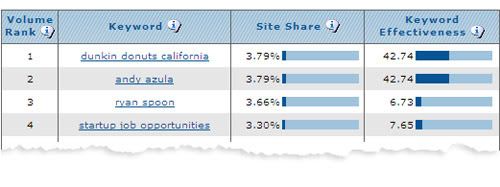
And so on. Those aren't short / intuitive queries ... and they occur thousands of times a week. I've even gone as far as to suggest a business model around natural search logs considering that Dunkin Donuts would likely find this information interesting. I've received offers to sponsor pages based specifically on the keywords it ranks well for. According to Compete, "Dunkin Donuts California" is the #1 affinity query to my site (I wouldn't go quite so far...):

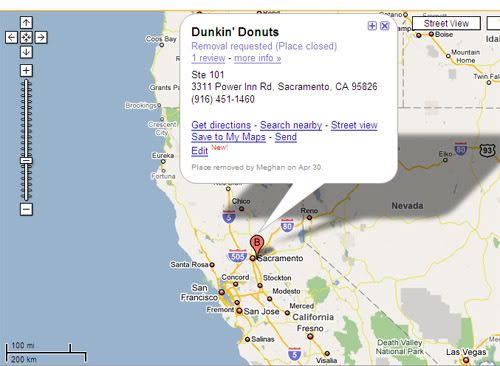
Search Google Maps for Dunkin Donuts and the only result is in California... and it's a closed location that has a request to shut down this listing:

According to Quantcast, "Dunkin Donuts" is the 1,700th most common search query on the web... yet despite California's size, population and collection of Boston-transplants, there isn't a single Dunkin Donuts in California. Why?!

beRecruited Surpasses 3,000,000 Recruiting Connections; Garners Press

It's been a big few days for beRecruited. Most importantly, we passed our 3,000,000th recruiting connection in late June - a significant milestone as it's a great barometer of beRecruited's growth and effectiveness. The 2,000,000th connection came just six months ago in early January (2008).

Another measure of beRecruited's effectiveness is the flurry of positive newspaper articles over the last few days. Each article covers athletes who found recruiting success through beRecruited - one even compared the experience to that of a highly sought after 'free agent'. These are just a couple of the stories that have helped us reach 3,000,000 recruiting connections - but they are testaments to the power of the service and the community (which makes all of us proud to be a part of it):

She shoots, she scores with online recruiters - The Globe & Mail

This fall, the 17-year-old Mississauga right winger will be lacing up her skates for Brown University in Rhode Island, thanks in part to a site called beRecruited.com, a sports-oriented social networking service that aims to connect amateur athletes with recruiters and coaches.... She posted her grades, her SAT scores, some personal information and her various hockey stats, and began including the link to her beRecruited profile with her college applications.

Within a few months, Ms. Wong felt like Mats Sundin might when fielding free-agency offers; in addition to holding discussions with the coach of the women's hockey team at Brown, she was fielding offers from half a dozen other schools that wanted her on their roster. Ms. Wong has since left the site, but is pleased with her results from going online.

"It definitely opened doors to schools that I might never have thought about playing for," she said. "It's a great way to connect with coaches and get your name out there, and it was cheaper than long-distance phone calls or driving down to talk to coaches, so I'm pretty sure my parents were happy about that."

Recruits Make Online Pitch - Atlanta Journal Constitution

Matt Houser, a 2008 Pope High graduate, recently signed both baseball and academic scholarships with the University of Charleston in West Virginia.

"Finding a school that was the right fit was hard," Houser said. "We tried other recruiting sources, some of which were very expensive. I had a couple of contacts through other services, but I found my school through beRecruited."

St. Charles Bound: The Bellville View

Chelsea Hardrick of Belleville High School was determined to take her diving skills to the next level. She was so determined that she went to berecruited.com.

It was a move that paid for her and her future. In the fall she will be attending Lindenwood University in St. Charles, Mo. So now this newly graduated Belleville Tiger will become a Lion.

"It is about eight hours from home on the road and only an hour and half by plane," Hardrick said. "I visited several other colleges but they offered me the most money."

beRecruited was also covered in the Rocky Mountain News: Stop the madness

Predicting the 2008 Jerry Yang and Yahoo in 2001

While sitting in the 110 degree Las Vegas sun yesterday (en route to the worst sunburn of my life), I read Jeffrey Zygmont's "The VC Way: Investment Secrets from the Wizards of Venture Capital" (availabone on Amazon here). There isn't a ton of literature written about venture capital, and Zygmont's 2001 book is neither a best-seller or a masterpiece (#113,459 on Amazon)... but it does offer an good overview of venture and a perspective from just after the .com bust. In a chapter written about the role of founders within fast-growing, venture backed companies, Zygmont wrote about Yahoo and Jerry Yang. This was written in 2001 and is eerily relevant and insightful considering today's circumstances, Yahoo's struggles and Jerry's changed reputation:

The reality runs contrary to the pervasive cultural myth that sees a boy-wonder techno-genius hopping a freight train to Silicon Valley with nothing but an idea in his head and a dream in his heart, turning them both into a commercial empire and managing at the same time to somehow woo Julia Roberts. the reality is a lot closer to the disposition of the two fabled founder of Yahoo, grunge-kids David Filo and Jerry Yang - who, as a version of the legend goes, were living in a trailer when they worked up the Yahoo Internet search engine as a hobby in 1994 while studying for their doctorate degrees at Stanford. They never quite ran the company. Yahoo incorporated in April 95 behind funding from Sequoia, led by VC Michael Moritz, who still sits on Yahoo's board of directors. Within a year, Tim Koogle was on board as president and chief executive officer. He became chairman in 1999. Jeffrey Mallett joined at about the same time as an executive assigned to take Yahoo around teh world. He is now president and chief operating officer. Other members of the management team arrived as early, including Anil Singh, senior VP in charge of sales and marketing, and Timothy Brady, senior VP of network services. Farzad Nazem, who joined in 1996, is Yahoo's current computer whiz, serving as chief technology officer. Today cofounder Jerry Yang is a corporate director. His partner David Filo is officially described by the company as a "key technologist." Bot are said to b "currently on a leave of absence from Stanford's electrical engineering Ph.D. program. Together Yang and Filo are listed at the top of Yahoo's Web-published roster of corporate officers. Their title: Chief Yahoo. It's very cute, but have to wonder what they really do.

"You can count on one hand the number of CEOs who have scaled from raw start-up to a multi-billion dollar enterprise," observes Greylock's Kaiser. "You think of Michael Dell, or Tom Stemberg at Staples, or Scott McNealy at Sun, or Larry Ellison at Oracle. Or Gates for that matter, But they're the exceptions, no matter how loudly they're celebrated. -- page 76-77

InGameNow Launches - Brings Sports Scores, Chatter Mobile

I haven't blogged much in the last week - but I have good reason: we've been hard at work on InGameNow... and, just in time for tomorrow's NBA Draft, we officially launched today! InGameNow: Twitter for Sports

As I have discussed before, InGameNow was launched and funded out of sfEntrepreneurs - an organization of ten local entrepreneurs with varied skillsets. After a couple months of intensive work in each of our 'spare' time, we have launched a product that we are very excited about. The concept of InGameNow arrived from the team's two shared passions:

1. We are all avid sports fans 2. We are all avid Twitter users

But we collectively were disappointed about the lack of a sports presence on Twitter - and personally, I am a believer that Twitter is effective for open, spontaneous discussions but struggles as a medium to follow structured events.

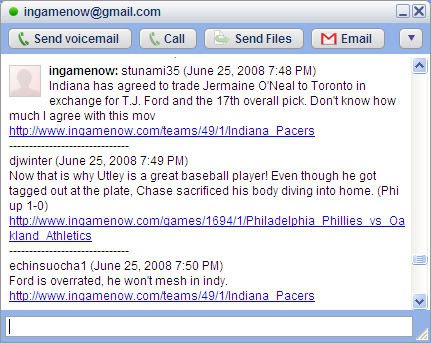
The end result is InGameNow.com which can best be described as Twitter for sports. With InGameNow, sports fans can interact around teams, players and games... most exciting, users can now receive real-time updates and scores via Google Talk, AOL Instant Messenger and Email (customizable by frequency and content) - so even if you can't attend or view your team's next game, you'll be able to stay up-to-date and engage with fellow enthusiasts:

For mobile users, you can either us Google Talk, browse directly on InGameNow.com (optimized for the iPhone) or schedule email alerts:

We also had a nice write up on Mashable:

A new sports community called InGameNow, from the creators of the recently acquired beRecruited, adopts the Twitter method of disseminating user-generated information on sports news reporting and commentary. In addition, these Twitter-like updates are filtered based on votes, so the best updates can bubble to the top. In true sports community nature, users on InGameNow earn points for site participation, and can work their way up the rankings in order to become trusted users...

If you're a sports fan, I encourage you to check out InGameNow. We aim to have an active night of posting for tomorrow's NBA Draft. And (as always) I welcome feedback either on the blog or directly via email!

Long Tail Analytics with Quantcast, Google Trends & Compete - Who Wins?

Google entered the public web analytics game yesterday by expanding Google Trends beyond search queries and into web traffic. Just a couple years ago, we had two options for web data: - Comscore provided detailed analytics for the web's top sites - Alexa (inaccurately) estimated traffic based on their tool bar users / usage

Now, we have three major players offering analytics for the tail of websites: Quantcast, Compete and Google Trends. Quantcast is, at this point, the only player that enables publishers to add tags to their site (or media: flash, network, etc) that effectively share their stats and make them public. This gives Quantcast full information about the site and its visitors (the same way that Google Analytics collects their data); they then share a portion of that information publicly and, for quantified publishers, that data should be trusted: pageviews, uniques, visits, etc. The beauty of what Quantcast has built is that publishers are incented to 'quantify' their sites because it provides a trusted 3rd party representation of their traffic - and for the tail of websites, that's an important differentiator because Comscore only measures the web's top sites.

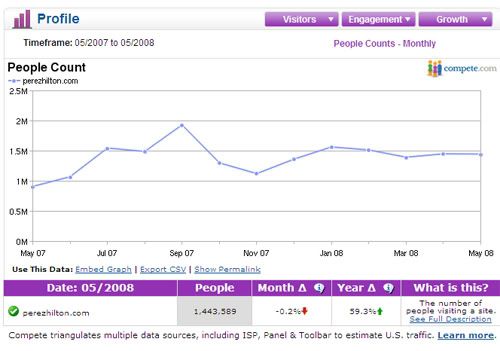
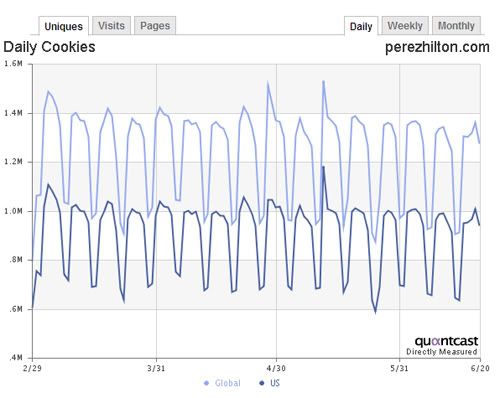
Meanwhile, Compete collects their data from a panel of users and releases monthly stats (for quantified publishers, Quantcast releases daily updates). Below, you'll see just how different Quantcast and Compete are for PerezHilton.com (who is now quantified). Quantcast shows 9 million monthly uniques and 1.4 million daily uniques - Compete shows about 1.4 million monthly uniques. Big difference:

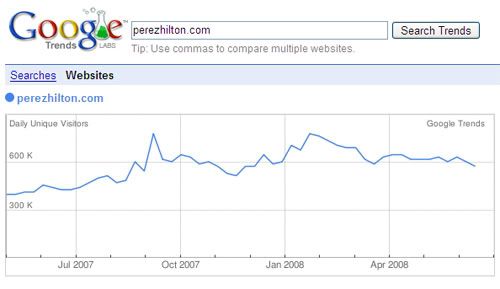
According to the data (3m uniques vs. 1m) and all of my anecdotal Silicon Valley conversations, Quantcast seems to be the preferred analytics provider over Compete.... but the real wildcard is clearly Google. The Google Trends launch garnered huge buzz yesterday - but it's yet to be seen how big of a step Google is actually taking. You'll notice below that Google Trends shows 600k daily uniques for PerezHilton.com - which falls between Quantcast and Compete... which leads to me to ask the obvious question: Will Google open up Google Analytics publicly on an opt-in basis? Quantcast has pushed Compete aside by gathering real data provided directly by the website owner. Google already has a massive footprint in Analytics - by providing an option to "make your data public", they can create a consumer-facing analytics service and extend the reach of AdWords / AdSense by matching demographics and allowing direct ad-buying.

The integration is easy and leverages Analytics massive user base. More importantly, it delivers accurate data and makes Google Trends relevant - because, as it currently stands, the data is good just that: trends.