Google AdSense Introduces 3rd Party Ads; Click Through Rates +2x

On Monday May 19th, Google notified AdSense publishers that they are now accepting 3rd party image and rich-media ads... a potentially significant upgrade considering that Google's image and video inventory is very weak as compared to traditional text ads. This is makes sense considering that it is magnitudes more difficult to produce video units than it is to produce graphical units; and the same can be said for graphical vs. text units. But it is in the publisher's best interest to have strong inventory in image and video ads:

- they usually have better EPCs / ECPMs. In a 728 x 90 unit, for instance, Google requires the graphical unit to out-value all of the text ads that would appear in its place.

- Simply put: Graphical and Rich-Media units are classier. I feel a lot better when branded ad units run on my site. It looks more professional, conveys credibility and seems to translate into increased CTRs.

But Google's inventory to-date has been quite poor. That's why the below news is exciting. It's difficult to determine how much new inventory has been flighted and what the change in value / revenue is... but it is apparent that new units are running and that they look far more professional. Additionally, without making any other changes to the site, my AdSense units have seen a 2x improvement in click-through-rates. As Google continues to strengthen their ad inventory and as the DoubleClick integration progresses, I expect continued improvements.

Greetings from Google!

We're happy to announce that the Google content network now accepts display ads served from qualified third-party vendors. During this initial release, only ads in English are eligible, although we look forward to offering more options in the future.

By accepting third-party ads, we can attract a greater variety of advertising on the Google content network, which we believe will result over time in increased revenue for publishers and more relevant advertising for end users.

If you're currently opted in to image ads, you're already able to receive third-party ads. If not, you can enable image ads to start receiving third-party ads immediately. (Learn how to enable image ads at https://www.google.com/adsense/support/bin/answer.py?answer=9741.)

If you choose to allow third-party ads on your site, please update your privacy policy to inform your visitors that third-party vendors may serve ads on your site. Please also provide links to these vendor websites and inform your users that they may opt out of cookies (if the vendor offers this capability). For more information about updating your policies, visit https://www.google.com/adsense/support/bin/answer.py?answer=94150.

You'll continue to have full control over which ads appear on your site with tools like competitive ad filtering and the Ad Review Center. Also, only advertisers with whom we have proven relationships and who've clearly demonstrated commitments to our quality standards may participate in this program. Our policies governing ad content and formatting remain unchanged.

To learn more about third-party ads, please visit our blog post at http://adsense.blogspot.com/2008/05/introducing-third-party-ads-on-google.html and our FAQ at https://www.google.com/adsense/support/bin/topic.py?topic=14535. If you have any questions or feedback, feel free to contact us at adsense-support@google.com.

Sincerely,

The Google AdSense Team

Google Inc. 1600 Amphitheatre Parkway Mountain View, CA 94043
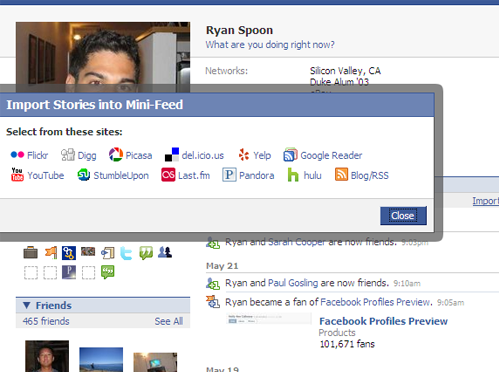
Should Facebook Acquire FriendFeed, Twitter and/or Digg?

Over the last few years - in *numerous* settings - I have heard different variations of the following: “Why should we build it internally when we can let it be proven elsewhere… and either build or acquire then?” This logic makes sense if you: 1) have the resources and manpower to build and/or integrate the product 2) have enough users that you can either catch up to competitors or accelerate an acquired company

I’ve thought a lot about this as Twitter and FriendFeed continue to grow and as Facebook has begun to experience declining traffic. My personal feeling is that, as products and consumer services, Twitter nor FriendFeed should really exist on their own; rather, they are products (pun intended) of Facebook’s oversight. Think about it – Twitter and FriendFeed are more powerful, distributed versions of the social feed.

And as Facebook’s traffic begins to decline, it’s increasingly obvious that they are taking note of this new generation of social interaction. Just yesterday, Facebook expanded their Feed product (making an obvious push into FriendFeed’s territory) and they are including more and more native profile enhancements (seemingly) modeled after utilities and applications built by 3rd parties and proven successful by the community.

What will become interesting is whether Facebook is able to push either Twitter or FriendFeed aside (or the next upcomer) … and with their massive user-base, that is a real possibility. Or, will Facebook become a web 2.0 acquirer (like Yahoo, Google and eBay)? Acquired web 2.0 sites like Delicious, StumbleUpon, and Flickr - and potential targets like Digg, Twitter and FriendFeed – might make a lot of sense to Facebook (and help invigorate their site usage).

Relevant reading: Techmeme's top few headlines are all about FriendFeed today

Grand Theft Auto IV Makes $600m, Niko Bellic's Actor Makes $100k

Grand Theft Auto IV will go down as the most successful video ever:

- Sold 3.6 million units in the first day - Sold 6 million units in the first week - Hit $500 million in sales in the first week

Michael Hollick, the actor and voice behind lead character Niko Bellic, will go down as the worst negotiator ever:

-15 months spent on GTA IV - $100,000 salary for his work - that's $0.016 per unit sold in the first week

The New York Times has a fascinating piece on Michael Hollick, "A Video Game Star and His Less-Than-Stellar Pay", and how the video game industry hasn't adjusted its pay scale for actors (despite seeing marked growth and revenue. Like the writer's strike, there is a discrepancy between traditional media and new media (video games and internet).

And Hollick recognizes the gap between his earnings and Rockstar's:

“Obviously I’m incredibly thankful to Rockstar for the opportunity to be in this game when I was just a nobody, an unknown quantity,” Mr. Hollick said. “But it’s tough, when you see Grand Theft Auto IV out there as the biggest thing going right now, when they’re making hundreds of millions of dollars, and we don’t see any of it. I don’t blame Rockstar. I blame our union for not having the agreements in place to protect the creative people who drive the sales of these games. Yes, the technology is important, but it’s the human performances within them that people really connect to, and I hope actors will get more respect for the work they do within those technologies.”

Can Michael complain? Sure. But I disagree for a few reasons.

First, GTA IV is not successful because of the actors. In fact, I am pretty confident that you could fill any actor's voice in there and the game would be just as successful and just as fun. Hollick may be a terrific actor (I have no idea) - but it really doesn't matter....

... because the real stars of any video game are the programmers (who enable the 'acting'). And they, like Michael, are salaried. If I was running Rockstar and was asked whether to remove the top few programmers from the team or replace the actors - I wouldn't even blink.

And Hollick agreed to the terms put forth. He agreed to accept $100,000 for the work - regardless of whether the game was an utter flop or a massive success. The entire industry knew it would be a success - so perhaps he should have asked for more? Or perhaps he knew that there were dozens of people willing to do that same job for the lowest available rate... and that Rockstar would be completely comfortable hiring other talent.

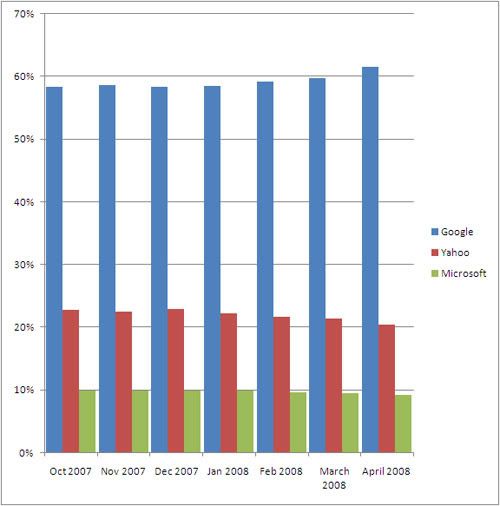
April Search Data: Google 61.6% of Market, Yahoo Falls to 20.4%

Much of the news today was around Facebook's 10% month-over-month decline in unique users - but the search query data out of Comscore is equally interesting (and important, particularly in light of the Microsoft-Yahoo deal).

Google gained nearly two points in search share - now representing 61.6% of US search queries. Google had sat around the 58% mark from October - December of 2008 and surged in April (breaking 60% for the first time). Meanwhile, Yahoo fell nearly a full point to 20.4%. Since January, Yahoo has falled 2.5 points (11%) compared to Google's 3 point gain (5.3%).

As Yahoo attempts to remain independent, their rapidly declining search share does not bode well or instill confidence.

Using Compete.com to 'Understand' Techmeme and Its Audience

If you’ve read this blog often enough, you’re aware that I’m a big fan of Quantcast. I’m also a fan of analytics software / providers and was excited to try out Compete’s new pay-per-usage analytics program. Compete now offers detailed data about websites or verticals – providing:

- Top Keywords, ranked by volume. - Site Share, percentage of all search referrals to a site via that keyword. - Keyword Engagement, index representing average amount of time spent after entering the site via that keyword. 100 represents that term resulted in the most time spent on the site. - Keyword Effectiveness, index that combines the total number of people referred by the keyword and the amount of time those people spent on the site. 100 represents the most effective term.

Conceptually, I love Compete’s model and would be willing to pay for usage… of course assuming that the data is accurate. I was skeptical at first considering that, unlike Quantcast and Google Analytics, Compete doesn’t have the most accurate form of data: embedded tracking on my site.

… My hypothesis was right. I pulled data on Techmeme and the results appeared fishy:

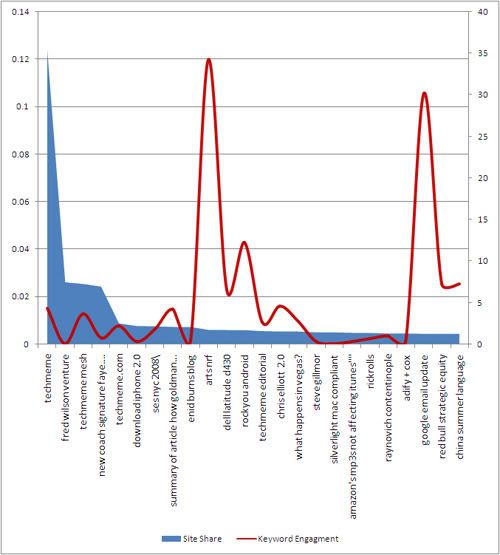
#1. Techmeme (12.4% site share, 100% keyword effectiveness)… obviously #2. Fred Wilson Venture (2.6%, 0.14%) #3. Techmeme Mesh (2.5%, 17.5%)… obvious again #4. New coach signature faye wedge shoes slides sandals (2.4%, 3.4%)… wtf? #5. Techmeme.com (0.9%, 3.8%)

Would you pay for data that accurately suggests that your branded keywords are effective? Even more problematic is that the unbranded keywords (what you really want) are clearly way off. Fred Wilson is thematically relevant, but shouldn’t be the #2 keyword by volume (or any other measure) - if it really is a blog, it would be TechCrunch (which represents 8% of Techmeme headlines). The below chart not only shows the bizarre variety of keywords, it shows the problem with including brand-related keywords within such data sets: they represent such a large portion of traffic that the it becomes impossible to compare the remaining data:

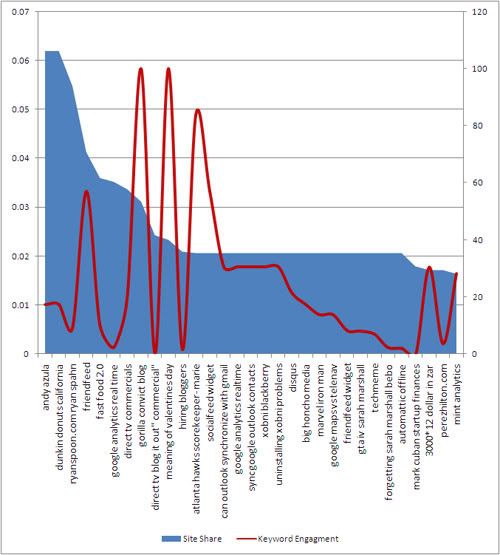
I obviously don’t have access to Techmeme’s logs, so just to validate that this data is troublesome, I ran the same report on my blog. The results were better (probably because I have less traffic and data to work with) – but still raised some serious questions. I’ve charted out the top queries below and, for the most part, am impressed with the keyword portfolio (except for bizarre entries like “Ryan Spahn” and “gorilla convict blog”, #3 and #8) - but the keyword volumes are way off.

I applaud Compete for pushing metrics into new, potentially powerful fronts. Unfortunately though, I’m not sure the data supports it yet. Additionally, Quantcast provides the same sort of keyword, audience and demographic data … which better accuracy… and for free. The first rule of thumb with analytics is accuracy is critical. And if you’re charging for that data - it really needs to be accurate.

Using Web 2.0 to Build Your Brand

672525791 This afternoon, I wrote a post about using web 2.0 to land a start up gig (or at least grow your personal 'brand'). Then, thanks to SlideShare, I came across these two presentations which cover roughly the same topic ... but much more creatively and interestingly. The first presentation is about using and contributing to web 2.0, which in turn fosters a public, online identity. The author apparently arrived at IBM after being identified through her blog. The second is about using the web within a company to improve culture, connect with peers, and be more effective.... Quite honestly, the first presentation makes more sense to me... but worth flipping through the slides nonetheless.

The Gen-Y Guide to Web 2.0 @ Work

Web 2.0 @ Work: In Pursuit of Passion

Landing a Great Start Up Job: The Best Job Resources

A great thread has been growing on Hacker News about the best place to find start up jobs. I've include the mentioned websites at the bottom of the post - but wanted to first give a couple higher level comments:

1. Read and participate on blogs. Fred Wilson commonly posts about openings in his portfolio and did so again yesterday. Reading his blog (and others) can inform you of opportunities - participating on his blog (comments, linkbacks, etc) can help you build credibilty. Secondly, most bloggers make their contact information available. My email is on the left side of every post and I, for instance, have job opportunities available. Read and be aggressive.

2. Most major blogs (like TechCrunch, GigaOm, etc) have job boards and have company indexes. Browse each. If a company is particularly attractive, visit their site and their job board.

3. Classifieds sites work - particularly if you live in the Bay Area. Craigslist and Kijiji have tons of listings. Search regularly and set up rss alerts. You can also be more proactive and post your resume.

4. Job search engines / aggregators work. Try JobFox.com, TheLadders.com, Indeed.com, and so on.

5. Network. Network. Network. Upcoming and other sites list start up events and conferences. Attend, engage and carry business cards.

6. Don't be deterred because a company has no job openings. If you're smart and are a great fit, they'll take you. You can never have an excess of excellent people (at least that's my view).

Best resources to find start up jobs (from Hacker News):

- TechCrunch's CrunchbBoard - CrunchBase - Hacker News Jobs - Sequoia Portfolio Jobs - KPCB Portfolio Jobs - HotStartupJobs - Startupers.com - Jowba.com - Go Big Network - StartupLogic.com - npost.com - SnapTalent.com

Google Analytics - 20 Ways to Fix Analytics. Please Hurry?

I’ve written a lot about web analytics and the importance of understanding and measuring your traffic. The resounding feedback I’ve gotten - and I wholeheartedly concur - is that Google Analytics remains the top used service but is far from satisfactory. Google Analytics is a fascinating product. Google acquired Urchin in 2005 and it remains one of the great, most overlooked internet acquisitions. They reportedly paid $30 million for Urchin.

Now Analytics is installed on nearly every website, gives Google insight into traffic patterns and integrates with AdWords and AdSense… thus enabling Google to upsell products through optimization and unified accounts. Brilliant.

But it also is a classic example of a product that really hasn’t changed because Google doesn’t have a great incentive to do so. It’s a free product, adoption seems to growing (at least from what I can tell) and the revenue association is around data and AdWords upselling (not enhancing the product).

Here are 20 ways to fix Google Analytics - taken from my frustrations and those I've heard / received from other users:

1. Provide an API. This turns Analytics into a platform, enables developers and allows me to define what I want to see.

2. Make it Real Time. I don’t care if this comes at a cost or how precisely real-time it is… but it’s a necessity. Right now, the only way to use Analytics is the day after - and the internet is increasingly about the now.

3. Enable Off-.com Tracking. This is huge. I’d like to be able to measure my ‘network’ data like Quantcast does. I could embed that code across my network’s content, widgets, and so on.

4. Bring Back Hourly Charts. I want to see in-day trends and data. Is my peak time at 12 noon or 5pm? This is important stuff that simply isn’t available.

5. Enable Exporting of the Entire Dashboard. I spent lots of time setting up my dashboard. Export the whole thing in a excel doc with tabs.... not just the pageviews.

6. Enable Multi-User Access to the Dashboard. I spent an hour customizing my dashboard. Why does everyone else in my company need to spend an hour as well?

7. Charting Customization. Seems simple right? I’d like to configure what the charts look like. What the scales are. The list goes on. The default charts are so distorted that you simply can’t figure out trends.

8. Add Dates to the CSV Export. Why do I have to add dates EVERY time I export data?!

9. Data Comparison With Other Websites. I have dozens of websites on Analytics. I’d like to compare them on basic stats like pageviews, visits, bounce rates, etc.

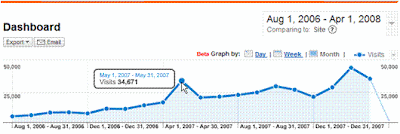
10. Add Trendlines. Trendlines are useful… particularly when graphs of overly distorted. A perfect use case: when the charts are moved from daily to weekly, the current week’s data should show a trendline / forecast rather than simply die.

11. Add Day-Over-Day, Week-Over-Week, Month-Over-Month. When I hover over a data point, I should be able to compare it to the previous day, week or month. Maybe I can also customize which that is?

12. Associate Referrals, SEO with Content Pages. When I drill down to top content or directories, I’d like to know more than traffic numbers. Give me the top referrals to this page, SEO keywords, etc. Otherwise I have to spend 10 more clicks and wait a minute for each page load. Speaking of which:

13. Improve Site Speed. The site is getting slower by the week.

14. Improve the Dashboard. I’d like to name the 12 modules I have on my Dashboard. I’d like to also add links to my other regularly-used queries. Perhaps a light-iGoogle integration here?

15. Make it Social. Analytics is regularly used across companies. It would be terrific if the company could communicate on Analytics about trends, data, etc…. much like Google Docs. The comments can be RSS enabled and results can be emailed to the DL.

16. Email / Mobile Compatibility. I’d like scheduled reports that provide the basic information via email: pageviews, visits, etc (very different than current emailed exports). I’d like them via email so that I can access at scheduled times and on the go.

17. More Goals. More Goals. Goals are currently limited to three. More! If it’s costly, charge. People will pay.

18. Session Information. There isn't much depth around user / session pathing. What are the most common exit pages? How does that change when users arrive through SEO? Registered vs. unregistered users?

19. Metric Comparisons. Analytics allows charting of very high level information, like page views vs. visits. I'd like to be able to chart any two data points on a two-axis graph and compare different metric sets. For instance, I'd like to chart page x, y, and z against each other using page views / visit and bounce rate. That currently is entirely manual - finding, charting, and exporting.

20. Make Data Public (On Opt-In Basis). This is larger than a feature enhancement and is more strategic: allow websites to make their data public as a medium to promote themselves, gain new users and understand where they rank within their vertical. To have your data shared, you'd be hooked into Google Analytics and a richer ecosystem would exist (with new revenue opportunities). This enables the start of some major ideas:

Think Google Hot Trends + Yahoo Buzz + Quantcast + Blogger.