Twitter & Friendfeed: Understanding Referral Traffic, Arriving at a Business Model

For consumers, the power of the distributed web is accessing and connecting content across one’s internet usage and social graph. For content owners, the power of the distributed web is precisely that: one’s content is distributed such that it attracts new readers and generates more traffic.

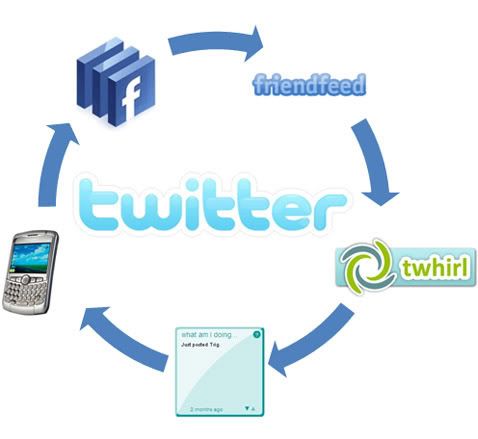
And as sites like Friendfeed and Twitter (and others) approach tipping points, they are becoming significant traffic drivers. And as sites like Twitter continue to open up via APIs and third-parties, that traffic itself is getting distributed (Twhirl, Twitterific, etc). My point in detailing this process is that social sites like FriendFeed, Twitter and Facebook are contributing very large percentages of referral traffic - with me, for instance, Friendfeed and Twitter are becoming two this blogs largest referrals; meanwhile, Facebook delivers very targeted, high volumes of traffic to beRecruited.

As this trend grows (*and it certainly will - the question is by how much*), it will become increasingly important to understand precisely where that traffic is coming from… which is currently very, very difficult. Aggregating traffic from Twitter is damn near impossible because it comes from so many sources and applications. Here is a small subset of traffic that has arrived at this blog via Twitter:

- Twitter badges on various blogs – which mark referrals as those blogs - Twitter.com (via different Twitter accounts / pages) - 3rd party apps (which represent a massive portion of Twitter’s usage): Twhirl, Twitterific, etc - Gtalk: which is marked as direct traffic - SMS-to-Mobile-Web: again, marked as direct traffic - Social / Status Feeds on sites like Facebook

Tough to keep straight.

Even tougher to understand what the true amount of traffic being delivered from these sites are. Consequently, it’s also tough (and near impossible) to understand the value of those sources and how much focus I should spend on acquiring traffic from those sources.

These questions are currently overlooked because the traffic levels are growing, but are still relatively small. But what happens when they represent 20% of your traffic? Those sorts of numbers have enabled an entire industry to exist around SEO.

So as I think about services I’d pay for - and as sites like Twitter think about business models - perhaps we’ve arrived at a start. I am not a believer that the two prominently discussed models will work (ads in streams and subscriptions). But, I would be willing to pay (and perhaps handsomely) for data around my account, users, content and traffic…. Because right now it’s a black box.

Disqus - After 5 Days on Disqus, I'm Turning Back to Wordpress Comments

I'm an avid reader of Fred Wilson's blog and was tempted to test-drive Disqus when Fred first integrated it onto his site. I finally decided to install it on my blog (which is powered by Wordpress) after Fred wrote his post "Three Reasons to Use Disqus". It's worth noting that installing Disqus is amazingly easy. I installed Disqus on Sunday... Today is Thursday and I have decided to remove it.

Why?

In concept, Disqus is bold and a clear improvement over static comments. I believe fully that threaded, social and portable commenting is the future of discussion and is certainly empowering for readers. I like being able to follow a user's activity across other blogs - for instance, I just accessed all of Gabe Rivera's Disqus comments (here) and arrived on some fascinating blogs (that I wouldn't have found otherwise).

As a blog owner, though, Disqus simply isn't empowering enough.... yet:

My core issue is that the content (and it can be argued that comments and discussions are the most important aspect of a site) isn't truly mine. It's rendered via javascript on my end and as direct html on Disqus.com. That means that I lose all of the SEO value of the comments (which is significant) and Disqus gains from it. Honestly, that makes me quite uncomfortable. A couple other critiques:

- Trackbacks are critical elements of a blog (SEO, navigation, etc). They aren't yet available with Disqus and are must-adds.

- Disqus doesn't provide commenter emails and contact information. Sounds minor, but I have engaged directly with numerous readers and formed deep relationships. Another must-have before I switch back. (update: according to Daniel Ha of Disqus email addresses are accessible; full response in below comments)

- The administration and deep interactions occur on Disqus.com - and consequently off my site. Furthermore, as the admin, there is neither enough transparency nor available configurations.

I think Disqus is close. And I expect that I'll give it another test-drive shortly. But it's going to take some additional benefits as a blogger (I clearly see the benefits as a reader); and as I think about services I'm willing to pay, perhaps that's the solution for Disqus: offer premium accounts. I'd be willing to buy that.

Charting Techmeme's Top 100 Headline & Discussion Sources

Techmeme has garnered a great deal of analysis over the past week: Statbot broke down the top 100 users, CrunchBase released a very thorough Blogger Board, and I argued that Techmeme's homepage is more effective and valuable than Digg's or Mixx's.

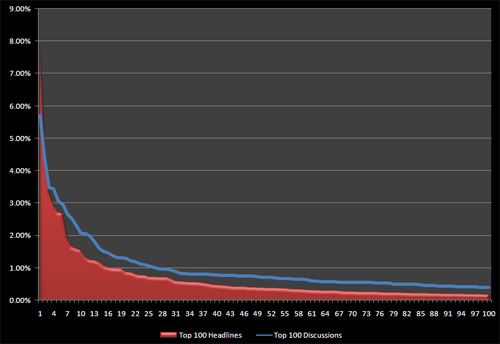
Below, I combined StatBot's Top 100 Discussion sources and CrunchBase's Top 100 Headline sources. I was looking to understand two things:

1) Techmeme's reliance on top sources in both Discussions and Headlines 2) The overlap between top Discussion and Headlines sources

The heads actually take far different shapes - which is to be expected. 17 different sources contribute at least 1% of Techmeme's headlines meanwhile, 28 sources contribute at least 1% of Techmeme's discussions. The fascinating part is that 25% of Techmeme's sources and 23% of its discussions are from 6 sources, respectively:

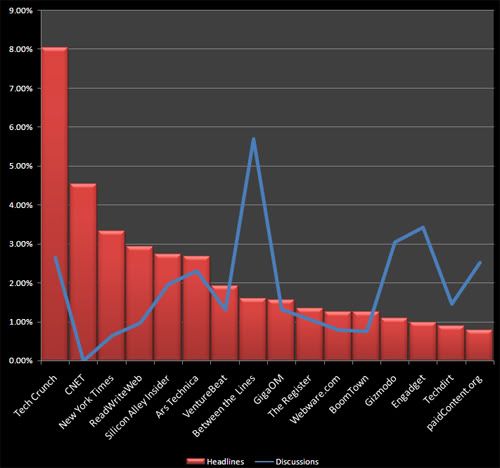
- Headlines: TechCrunch (8%), CNet (4.5%), NYTimes (3.3%), ReadWriteWeb (2.9%), Alley Insider (2.7%), Ars Technica (2.7%) - Discussions: ZDNet (5.7%), Digg (4.4%), Wired (3.5%), Mashable (3.4%), Engadget (3.1%), Gizmodo (2.9%)

The less pronounced (ie flatter) chart for Discussions is predictable as it is far easier for an 'average' blogger to make Techmeme's Discussion Algorithm... it's far harder to qualify as a Headline because Techmeme's algorithm values a mixture of credibility, linking, news breaking, etc. Consequently, the Discussion tail is more distributed and the Headlines 'head' features very big names.

Equally interesting is the overlap (or lack thereof) between top Discussion and top Headline sources. For instance, there are less than 10 sources that represent at least 1% of Techmeme's discussions and 1% of their sources. Why?

- As mentioned above, Techmeme's Headline algorithm values prominent, news-breaking sources (like TechCrunch, NYTimes, CNet, AP, WSJ) - Big sources like those are less likely to 'discuss' topics (ie respond) because either they are breaking the news or because it is not likely that major news sources engage in blog-like responses and linking

In fact, of the 17 Headline sources with at least 1% 'presence', seven are major companies / news sources (like WSJ, AP) and the remainder are major blog brands (TechCrunch, GigaOm, Venture Beat, Alley Insider). Only three sites have at least a 2% presence on both Headlines and Discussion: TechCrunch, Ars Technica, and Alley Insider.

A New SEO Business Model - Selling Your SEO Data / Logs?

Here are a few of the search engine queries that delivered traffic to my blog this morning: - Dunkin Donuts California - Google Analytics Real Time - Google Analytics Real-Time - Xobni Blackberry - Xobni for Blackberry - Direct TV Commercials - Google Analytics vs Slimstat - How to Synchronize Outlook with Gmail - Sync Google Outlook Contacts - Uninstalling Xobni Problems

If compiled over time and with more specific information (geographic, etc) - this is valuable data. Do you think that Xobni would be interested in the volume or "Xobni Blackberry" queries? Would Google be interested in knowing how many people are looking for real time Google Analytics or having trouble syncing Gmail with Outlook? There are no Dunkin Donuts in California - but I get enough search queries to demonstrate that DD would have a healthy following... they'd surely be interested in that data (particularly if zip codes can be associated).

While my site traffic isn't massive - I have 100,000s of data points like those above. TechCrunch and other larger sites are sitting on far bigger sets of data that would be massively valuable to CMOs, product managers, advertisers, and others. Companies often launch preliminary paid search campaigns to test user appetites for certain keywords and copy... that data could be made available via natural search and effectively reveal user intent, query volume, competition, product strategies, etc.

I am not sure how the marketplace for this sort of information would work - obviously user privacy needs to be respected and it's technically complicated. I also wonder if this opens up an ad marketplace. For instance, would a web analytics company want to advertise on targeted pages where traffic arrives from the query "Google Analytics Real Time" or "Google Analytics vs Slimstat"? The impression volume likely won't be high - and it would require a long tail of content - BUT the CPMs would be very high.

Craigslist, Kijiji & Oodle: The Geographic Distribution of Classifieds 2.0

One of my primary attractions to sites like Twitter, FriendFeed, Facebook, etc is that they are predicated on distribution and portability. But a recent New York Times article ‘Craig Looks Beyond the Web’ made me rethink the definition of distribution. The article describes how Craigslist has added over 250 new locations (ie [city].craigslist.org) to expand their reach and help drive growth (of note, Kijiji launched in the US in 200+ cities – a complete list is available on www.kijiji.com):

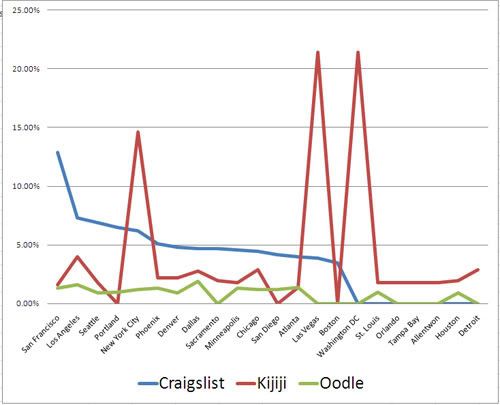
The fascinating part is in understanding how ‘distributed’ each of the big three classifieds sites are: Craigslist, Kijiji and Oodle. Using Quantcast’s public data, I charted the percentage of traffic that each city represents for its respective network:

The results are very interesting and suggest that distribution is quite different for each site and brand:

- 13% of Craigslist’s traffic is from San Francisco (where CL got its start). The bay area represents less than 2% of traffic for both Kijiji and Oodle.

- Oodle doesn’t appear to be heavily dependent on any particular city because their UI is unique and based on zip codes and refinement by locale. Craigslist and Kijiji have geographic hubs.

- Outside of San Francisco, Craigslist’s traffic break down is rather linear / stable while Kijiji is far different and more diverse: Las Vegas and Washington DC are +21% and New York City is ~15%. Are these cities that Craigslist has struggled in? Or, are they large enough that they can support multiple sites?

- Within each network, there are prominent cities that are quite surprising: Craigslist (Portland = 6.5%), Kijiji (Detroit = 3%, Allentown = 1.8%), Oodle (NYC = 1.2%... quite low comparatively)

Note: where the line is at 0% - it means that the data is not available on Quantcast as it is not one of the 20 most active subdomains on the site.

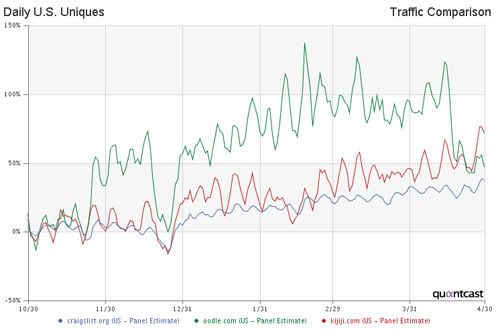
Also worth noting: each of these sites is growing quite quickly. This chart is also from Quantcast (can you tell yet that I use them all the time?) and displays the relative growth. Craigslist in blue; Kijiji in red; Oodle is green.

More data available at Quantcast (Craigslist, Kijiji, Oodle)

The Front Page Effect – Why I’d Rather Be on Techmeme than Digg, Mixx, etc

On Friday, I had my first Techmeme ‘headline’ and it offered the chance to compare what I refer to as “The Front Page Effect” – what happens when your website / article appears on the homepage of social news sites. Based on my experiences and what data I have available on my websites, I am going to include the following sites: - Digg - Techmeme - Hacker News (YCombinator) - StumbleUpon - Daily Aggregators (for my purpose, Sports Illustrated’s Hot Clicks) - Top Blog Mentions (in other words, having a major blog link to you in a prominent way. For my purpose, Deadspin) - Second Tier Social News like Reddit, Mixx, etc

My conclusion will likely surprise you… as it surprised me until yesterday. So here it is: I’d rather have my article hit the front page of Techmeme than any other social site. And here’s why:

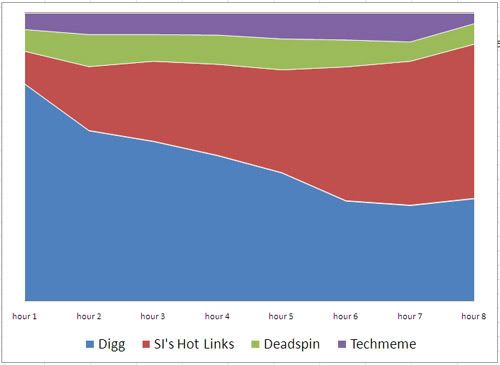
Traffic (Absolute & Velocity) If you are after traffic – and for some websites and companies it’s the most important factor – there is no question that Digg is the most impactful. Hitting the front page of Digg can deliver up to 50,000 uniques within 24 hours… which is incredible. In fact, the traffic comes so quickly that it often causes a “Digg Effect” – either bringing a website to crawl or collapse. Digg delivers 25,000-50,000 uniques (depending on the article and category) – but it also delivers a 1:1 visit / pageview ratio… meaning that bounce rate is essentially 100%.

After Digg, the most powerful traffic driver is being linked from either a daily aggregator or a prominent blog. As examples, Sports Illustrated’s Hot Links drives 10-20,000 uniques and Deadspin can drive 5,000. Traffic comes steadily for 24 hours and then disappears into what the archives of content… in other words, don’t expect residual traffic.

Techmeme and HackNews deliver consistent streams of traffic. Techmeme drove 2,500 uniques to the featured post on Friday and having the top post on Hacker News will bring ~1,000 uniques. Visits coming from both sites seem to be longer than traffic arriving from Digg (1pv/visit) and blogs (1-2pv/visit).

It’s tough to know whether you are ‘featured’ on StumbleUpon. A very popular page on StumbleUpon will generate strong traffic – but it’s unpredictable and consequently arrives in spurts. It’s also very tough to measure.

No offense to Mixx and Reddit (and I quite like Mixx) – but the traffic really isn’t significant.

Comparison: Traffic Volume Delivered Over First 8 Hours
Reader Engagement

If you are after pageviews, Digg is the most powerful lever you can pull … but multiples. But, it is not great at driving user engagement on your site (comments, emails, backlinks, etc). Digg users are used to interacting on Digg.com – often discussing the article with Digg’s community. This effect also exists with links from prominent blogs or inclusion in daily aggregators: users are finding your site through other locations and communities that they are already interacting on. Users will commonly return to those destinations for discussion.

The highest level of engagement comes from Techmeme and Hacker News – both of which deliver very high quality interaction… in high quantities. The resulting comments and emails are very intelligent and relevant. If you are writing for traffic, focus on Digg. If you are looking to build a community or drive conversation on your blog – try Hacker News and Techmeme. Revenue

In general, you won’t get rich from a front page mention unless you are selling CPM ads. Of course, you can value the traffic in other ways (brand, site growth, etc) – but if your ads are on a per-click or per-lead basis, your eCPMs will fall dramatically. As an example, Digg will deliver 25-50,000 incremental pageviews… but the overwhelming result is a pageview and, after reading the content, an exit. This is consistent with traffic from major blogs, aggregators, etc – and my hypothesis again is that the user mindset is to consume and return to their original destination. eCPMs will not fall dramatically though because the traffic is not as significant.

Meanwhile, I was very surprised that CPMs and advertising revenues went after the Techmeme link. eCPMs increased by 5x and I had my highest revenue day ever for this blog… Two hypotheses (and they are just that):

1) if Techmeme delivers more engaged users (per my earlier point), they are likely to be more valuable 2) Techmeme delivers higher ‘value’ users in that they are heavily tech

SEO Impact This blog has been around for just a few months and it’s already a pagerank 5. I attribute a good portion of that to Digg, Techmeme and Hacker News – which are all highly valued by Google and deliver additional blog links, etc… creating a virtuous SEO cycle. (I also attribute a good portion to my SEO background!)

I have no way of accurately ranking the SEO value of these sites – but Digg and Techmeme are powerful. Hacker News is as well. The others are less prominent and not as optimized for search.

Brand It’s also important to consider the ‘brand’ impact of making the frontpage. I would argue that appearing on the front door of any of these premier sites is good for establishing a brand / name… after all, the NYTimes and TechCrunch are regulars on both Digg and TechCrunch. If you are in technology, Techmeme brings credibility and suggests that your article is beyond just interesting – its important. Links from top blogs bring credibility in that respective vertical… also important in building a brand.

So here’s the one line summary (with enough punctuation to make it capably lengthy):

An appearance on Techmeme’s homepage (or other vertical-specific hubs) delivers 1/15th of the traffic that Digg.com can; however, that traffic is more qualified and more engaged – and therefore more valuable.

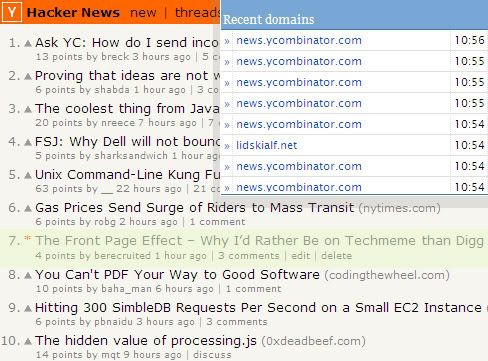
*Update* After posting this article, it's gone to frontpage of Hacker News (which has a surprisingly high volume of traffic for Sunday morning). As you consider the impact of social media on your content and websites - it's important to remember that you need to be able to measure the results. Here is a screenshot of SlimStat (a plugin I use for Wordpress) - but you can analyze your logs, use Google Analytics, Mint, etc. Everyone's data will be different and the critical part is knowing what works for your site and your readers.

Also, I had a couple people ask me if this means that I no longer like Digg and let me be clear: I love Digg. I use it routinely as a reader and publisher (probably too much). It has become one of my core navigational start-points for the web.
*Update 2* Techcrunch has posted about the top 100 bloggers based on Techmeme

15 Websites / Services I'd Actually Pay For

One measure of a service’s utility and stickiness is its ability to charge for usage. Consequently, I regularly find myself asking, “Is this important enough to me that I’d pay for it?”

Here are some of the services / sites where that answer is yes… And what I’d be willing to pay: Gmail: I’d pay to keep my Gmail account more because the switching cost is high than because of the functionality. That switching cost is painful enough that I’d spend $75 to prevent it. I will likely end up paying for increased storage too.

Google Maps: Love Google Maps for my Blackberry. Telenav is $9.99 / mo and offers greater functionality – I’d likely pay $10 to download Google Maps or some nominal monthly fee. If Google Maps added navigational directions, I would pay $10 / month.

Wordpress.org: The benefit of blogging with WP is so significant (SEO, functionality, flexibility) that it’s well worth paying for. I’d probably pay a $200 for an installation… which makes me realize how much I rely on the product.

Google Analytics: If Google analytics weren’t free, I would unhappily pay a monthly fee to install it ($10) because, despite my disdain for the interface and lack of real-time metrics, it really is a necessity.

Google Analytics w/ Real Time Data: I would certainly pay extra for real-time Google Analytics.

Slimstat: Slimstat is a free Wordpress plugin that delivers real-time analytics. I would pay $40 to install it.

Slimstat “Premium”: … And I’d pay a lot more if Slimstat offered a model with unlimited data capturing / storage (the basic one shows the last ‘n’ records). I would pay $100 / domain.

Mint Analytics: I gladly paid $40 to install Mint on my domains. Great data and great interface.

Craigslist: I would pay for premium listings on Craigslist (if they introduced some sort of featured ads format) and I’ve paid the jobs listing fees before (many times).

Amazon Prime: I spend enough on Amazon that they gave me Amazon Prime for free when it first launched. Considering that I buy my groceries, toiletries, electronics, dog food, etc on it – I’d pay for Prime if Amazon forced me to.

iStockPhoto Premium: I love iStockPhoto – but it’s a pain to purchase credits. I’d pay for a premium account that enables power-usage.

MLB.tv: MLB is the only major sport that has truly adopted the web and their radio and video streaming is fantastic. I already pay for the service (estimates: $14.99 for radio broadcast of all games,$99-$179 for video)

Podcasts / On-demand Radio: There are certain podcasts and radio shows that I would pay to be able to download in entirety. For instance, I love The Thundering Herd on ESPN Radio but it streams too early on the west coast for me to catch it – and the Podcast only captures 30 minutes of the broadcast. I would pay $5-$10 a month to listen to it on-demand, in its entirety (price depends on whether or not ads are in the broadcast). The same can be said for Tony Bruno and JT the Brick.

eLance: I love eLance. Use it all the time. They choose to charge the service provider – but if they reversed it, I would pay on a per-listing basis. The price depends on the project, but a nominal amount ($5?).

ESPN360: It’s the only way that I can catch Duke games without leaving work at 3pm pst... I’d pay either per game or per month ($5-10) for the service. I’d pay a whole lot more if they could include MLB, NFL and NBA (would start to challenge my Comcast bill).

Blackberry 9000 Video - First Look is Impressive

If you haven't yet switched over to an iPhone (like me), you are probably excited for the new Blackberry 9000. The first videos look great... although the presenter makes a terrific point: this is not a revolutionary phone. Rather, it's evolutionary.

The interface, OS and form are all revamped - but are essentially improvements. I am excited about a couple things:

- a faster OS (huge need) - the screen (looks amazingly crisp) - video capture (the camera improvements look great)

Not excited about the size. I much prefer the Curve to the 8800. It doesn't look much different, but the 8800 is far bulkier. I also want to know more about the internet browser (desperately needs the ability to run multiple browsers) and what native apps the 9000 comes with.

Grand Theft Auto IV's First Week Sales: $500mm and 6mm Units

GTA IV somehow proved to be even bigger than the expectations. Tomorrow morning, Take Two Interactive will report that Grand Theft Auto IV:

- Sold 3.6 million units in the first day - Sold 6 million units in the first week - Hit $500 million in sales in the first week

The New York Times notes that these results beat analyst expectations by 20%.

To put this in perspective, last weekend's opening of Iron Man brought in a record-breaking $201mm globally... GTA IV did 2.5x that. Of course unit prices are drastically different - but these are massive numbers.