Google's Mobile Strategy is a Winner: Build Winning Apps, Monetize Later

All the talk around Google's mobile strategy is around Android and the Open Handset Alliance. But Google's other mobile strategy seemingly goes unnoticed because it's less sexy and dramatic: build compelling apps that sit on the mobile dock and drive monetization later. I live on my Blackberry and there are only so many icons that can make it to my 'desktop' beyond the regulars: inbox, calendar, contacts, etc. All the other slots belong to Google:

Gmail, Gtalk, Google Maps, Google Sync, Google Calendar, iGoogle

There are a couple themes with all of their apps:

1) They fully leverage the Blackberry and are integrated into the platform (ie I can set separate alerts for gtalk conversations, GMail messages, etc) 2) They each improve the Blackberry and are far richer than a link to a mobile page (see ESPN's talk on going mobile...) 3) The apps are constantly being upgraded and undergoing version enhancements 4) The apps provide increased utility on both the mobile and web experience

My biggest appreciation though is that Google has invested in each of these apps without inserting monetization directly into them... Instead, Google is using the apps to drive greater usage of the Google platforms, which they are better able to monetize. For instance, I converted to Gtalk and Calendar exclusively because of the Blackberry integration. Unlike AIM, I now never have to sign on/off or have multiple instances of the client running.

And perhaps most importantly for Google, it's given them a mobile presence to extend their new AdWords offerings - greater demand (pageviews) will drive greater supply (advertisers and ads) and thus greater revenue. Ultimately, Google's suite of mobile apps have made me a more loyal Google user, helped boost their mobile ad reach and will play a key role in the forthcoming Android launch.


Search

A better way to search with Google from your mobile

Maps

Locate nearby businesses and services

GmailNew!

A faster way to get Gmail on the go

SMS

Get quick info from Google

YouTube

Watch and upload videos from anywhere

GOOG-411

Use voice to find local businesses on the go

Digg Unveils New Algorithm... Is Digg Trying to Become Techmeme?

Digg and Techmeme are two of my favorite websites - visited routinely throughout the day. They satisfy similar needs but do so in completely different ways. Techmeme is an efficient way to scan what's important on the web (important being the key word) and cluster topics with other relevant sources / bloggers. Digg is an effective way to digest what's unique and interesting on the web (not always important). Both Techmeme and Digg change throughout the day and give me a reason to press the refresh button...

There's another important use-case for Digg: as a content publisher, it is an effective medium to drive traffic.

But rumblings across the web are that Digg changed their algorithm today - making it harder to reach popularity and harder for the non-power-users to find success. Two Diggs One Cup, 200 Diggs 1 Voice, and Valleywag are reporting that Digg has now instituted a 200 vote barrier to reach popularity.

The Digg story has nearly 300 comments - and the vast majority are angry. My thoughts are simple: I use Digg as both a consumer and publisher of content precisely because it is a level-playing field. If Digg institutes new algorithmic changes that drastically alter that balance, they'd likely lose the variety of headlines that make the site endearing and, instead, showcase topics near-and-dear to the power-users (ie all things Ron Paul or Apple).

Consequently, Digg could look a lot like an editorialized version of Techmeme.... And I like Techmeme enough that I don't need to replace it!

Update: Techcrunch has posted a review of the Digg changes with hints that new accounts are over-valued in the new algorithm.

Apple Announces Earnings, Stock Falls Under 140.

It's been a very tough time for the stock market and the tech companies have suffered. eBay, Cisco and others are trading at 52 week lows. Google has fallen from a November price of ~750 to ~580. And now Apple (the current glam company) has fallen from Wall Street's grace. After announcing today, shares of Apple plunged more than 11% in after-hours trading to $137.65 -- at the turn of the new year, AAPL was sitting at 200:

Is Google Testing a New AdSense Feature? The 'More Ads' Button

I wrote earlier about Google's bizarre AdSense behavior on this blog. Tonight, I noticed another strange occurrence which appears to be a new feature that Google AdSense in testing.

Tonight, I added an open air, text 468x60 unit atop the single posts. (As an aside, it took about 45 minutes for Google to start serving ads on the site - far longer than regular!). On the very first instance that the unit appeared, a "More Ads" link appeared in bold directly next to the Google logo on the bottom right corner. I had never seen this before. I pressed refresh about 30 times until I saw it happen again - making me comfortably confirm that this is a test.

Google AdSense Test

The More Ads link arrived at a very strange page that had nothing but two units appear on it (essentially the same ad unit on a blank page). I have included a screen shot below. It's remarkably strange because you would expect the page to have, clearly, more ad placements than what had appeared on the initial viewing. But rather than a AdWords-only search results page, I get two units on a blank page. Bizarre.

AdSense New Unit

Has anyone else had this appear? How does the 'More Ads' convert compared to normal blocks? And do you get paid on a click on the 'More Ads' text?

Andy Azula - The Artist in the UPS 'Whiteboard' Commercials

I've had too many conversations the UPS 'Whiteboard' commercials. I personally find them relatively creative, but not a single friend of mine agrees. I know this because UPS airs the commercials during every quarter of every NFL game. The next discussion point immediately moves to, "Who is the long haired artist?" Again, I personally think that he is a pretty talented and creative cartoonist (right word?) - but everyone disagrees. And I am always alone in saying that the artist must be famous... after all, how could UPS run a multi-million dollar campaign with an actor or a random guy as the focal point?

It turns out that the answer is somewhere in between, and it's fascinating. It turns out that the actor is Andy Azula and he is the creative director for The Martin Agency. He came up with the 'Whiteboard' concept, got UPS on board and became the face of the campaign. So there you go.

Wikipedia continues: "Andy Azula is a creative director for The Martin Agency, who achieved notoriety after starring in a series of advertisements he created for the United Parcel Service in which he draws on a whiteboard. The ads were directed by Errol Morris. Azula began his career at Leoffler Ketchum Mountjoy. He won awards for his work on North Carolina Travel and Tourism. He later worked at Fallon McElligott in Minnesota where he developed the Buddy Lee campaign for Lee Jeans. He also worked at Goodby Silverstein and Partners and McCann Erickson in San Francisco,[1] creating advertising campaigns for Microsoft. His accounts have also included BMW, Budweiser, E*Trade, and MSN. His work has won him a number of Cliowards, the advertising industry’s highest honor."

Donating to Goodwill - How can Goodwill go Web 2.0?

Trying to finish up my move, I brought a ton of stuff over to the local Santa Clara Goodwill store / donation center. I was surprised by a few things and finally left wondering how Goodwill can use the web to improve their service and increase their output.

First, the store / donation center was *packed* (mind you it was a Saturday). There were not enough people working at either the store or the donations center to meet the demand.

Second, the quality of donations (obviously) varied drastically. Even within my donations. For example, I donated close to 30 shirts. Some were $5 t-shirts and others were barely worn polo shirts.

So I am left wondering the following: How do they price their donations for sale considering 1) the overwhelming number of items, 2) the underwhelming number of employees, and 3) the significant variance in goods pricing?

I imagine they will struggle to determine the appropriate value for my Polo shirts vs. my t-shirts... and will probably suffer in terms of 'revenue' generated for the organization. From my experience as an eBay employee and seller (200+ feedback), pricing goods in critically important to determining the ability to sell an item quickly and its final value.

Now I have no idea if Goodwill uses software or applications to monitor inventory and determine / move pricing, but there are openings here to leverage work done through other sites with relevant data points - and if a killer app was built, it would has implications far beyond Goodwill's use (think eBay sellers, Craiglist users, and so on):

- eBay's APIs can reveal fair-market pricing for items. I would most likely pull the average price for a brand (not a specific item), include the word used and sell at a marked deduction (say 20%). If it doesn't sell in a week, automatically reduce its price by 5% until it sells. Let's use my clothing donation as an example: for the polo shirt, find the average price for "Polo Shirt" and use their taxonomy to select only: sold items, long sleeves, and pre-worn. There are 2,000+ such items and an average value of something around $40. Sell it for $32 and you now have a price that is both accurate and set to move the product.

-  eBay is the ideal source for Goodwill because their inventories map nicely - but for other product categories, Goodwill could look to Amazon (electronics), Craigslist / Kijiji (furniture), etc and then reduce the price by a set amount.

- Moving inventory is critical for Goodwill because they have limited 'retail' space and inventory is constantly streaming in. Thus, I would do two things:

1) As mentioned already, I would continually reduce prices by a fixed percentage based on 'time on shelves'. It needs to move and the space isn't worth the extra $5 it can fetch with the right buyer.

2) Use Craigslist, Kijiji and Postlets to drive traffic. All of these sites do terrific jobs driving demand for items. Just post an ad for a "Garage Sale" on all three sites and you'll get enough replies to fill your inbox. If Goodwill can move their inventory list online (see below) - they can now bulk load it to sites like Craigslist and Kijiji through aggregators like Postlets. Not only will this deliver demand to the stores, it showcase Goodwill's inventory and hopefully attract new, local consumers.... after all, Craigslist and Kijiji have proven that buyers will travel anywhere for a deal.

So - how does Goodwill get their inventory online (or, at the least, into a spreadsheet) in an effective, automated manner? There are a couple ways: Instead of giving people carbon copies of receipts (which are poorly itemized anyhow), set up a portal that allows users to itemize there and receive an emailed copy later. The cost would be minimal (and would be made up quickly) and donors would love the option (I will certainly lose my receipts!). Finally, when items are priced on eBay (and equivalents), store that price electronically and map it to inventory... next time a long sleeved polo shirt is donated, a 'price sold' will be available.

And if you want to get really creative, the items could be bulk loaded and showcased online. I don't think this is worthwhile on an item-by-item basis, but there was enough great 'stuff' available that it could make sense to showcase...

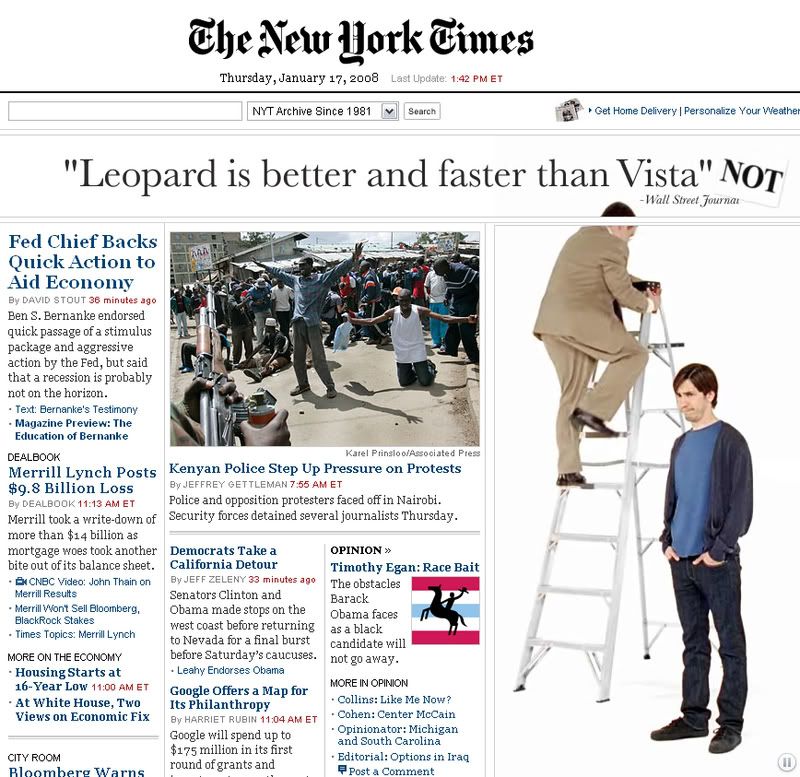
Apple Has Terrific Ad in New York Times: "Leopard is Better Than Vista"

Terrific ad on the New York Times homepage from January 17th that shows how brand advertising can be done correctly. It's smart, consistent with their TV campaign, and takes advantage of multi-ad sizes in a collaborative way. It really annoys me as a consumer and an advertiser when ads appear on the same page, in different formats (normally 728x60 and 160x600) and they are effectively the same ad.

Apple Advertisement Leopard

See full image here.

CribCandy.com and Wists - I Can't Get Enough. Seriously.

In my move to San Francisco, I have relied heavily on blogs and shopping destinations like RoomAndBoard.com to furnish my place. I happened across CribCandy.com and had two reactions:  1) I love this site. It's freaking awesome and I just wasted 15 minutes of my day viewing 200 different pages and products that:

a) I would have never found otherwise b) I definitely can't afford 

2) I want more.... CribCandy, part of Wists.com, is web 2.0 while being stuck on web 0.5. There is no productive way to search. No browse paths other than a few tags and a previous / next button. There is no way to interact with other users and/or create my own CribCandy.com. Why can't I build my own home?  Why can't I showcase my own collection? And what if I want to showcase my unfinished room and gather input for what's needed?

I want to do all of those things - but can't. So instead, I am stuck viewing page after page of awesome product wondering why there isn't an awesome finding experience to match.  I guess I am looking for some combination of:CribCandy meets Polyvore meets Amazon meets StumbleUpon.

Why Can't I Sync Google Calendar, Contacts With Outlook?


Earlier, I wrote about how Xobni made Outlook better, but failed to make my email universally better. And I've actually been wanting something to tie my e-content together long before Xobni launched.  I have three computers, six email accounts, a blackberry and information spread throughout them. When I left eBay, I spent way too long transferring my e-rolodex to Gmail. Why Gmail? Because I live on my blackberry more than any other device, and Google's mobile releases are terrific on the berry. That solved part of the problem - but still isn't close to enabling active syncing between even my Outlook and Google accounts.

Why does Google treat my calendar, email and contacts as distinct properties? Isn't that why Outlook is so powerful? And why can't I turn on an extension through Outlook to actively sync through those Google properties?It kills me.

And I know that plugins exist to do some of the discussed actions - but I don't need 10 different plugins (especially when I haven't found one that works well).